
284 million euros for an unfulfilled promise
Our investigation into public funding for insect farming
How much public money has France invested in insect farming? And what have been the results? To answer these questions, ONEI has partnered with the Observatory of Agricultural Subsidies and Aid in France (ObSAF) to track public funding to the French insect farming sector over the past decade. The full report is available for download (in French, English translation available soon).
In light of this report, we are calling for a moratorium on all new public funding for the insect farming industry in France.
In a climate of budget constraints where every public euro counts, it is unacceptable to continue funding an industry whose economic viability and environmental benefits have not been demonstrated. The resources the government can devote to the food transition are limited. They must be directed toward solutions with the best-established effectiveness, not toward industrial gambles whose promises have not stood up to scrutiny.
You can sign this petition on the ObSAF website:
What the investigation shows
Our research identifies at least 284 million euros in public funds committed to France’s leading insect farming companies. When scaled to the sector’s actual production, this amount represents approximately €20 in public aid per kilogram of insect meal produced, even though this same meal sells for between €3 and €5 per kilogram in a market that is already struggling to find buyers. This figure of 284 million euros should, however, be understood as a conservative estimate: significant amounts of support for the sector could not be identified, particularly because BpiFrance is not required to be transparent.
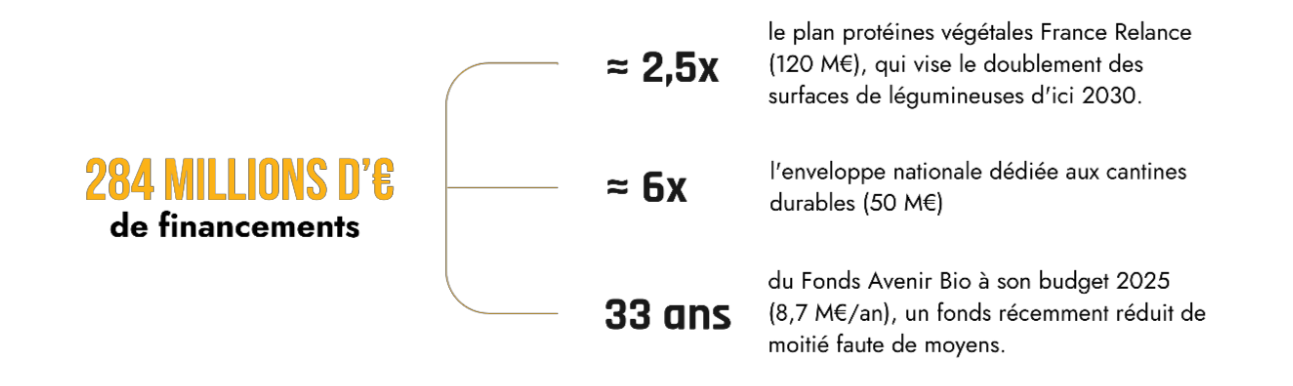
More than 90% of the funding comes from the government or its agencies, foremost among which are Bpifrance, ADEME, and the Caisse des Dépôts. The instruments used are varied and not limited to traditional grants: €123 million in loans and repayable advances, €60 million in equity investments, and €94 million in direct grants. This indicates that the government has assumed a significant portion of the economic risk.
An industry in trouble
The last years have been difficult for the industry. In France, Ÿnsect went bankrupt in December 2025, after raising more than 600 million euros since its founding. The Toulouse headquarters of Agronutris had been closed a few months earlier, and the factory was sold. Innovafeed, still in operation, reported revenue of €5 million in 2024, along with a net loss of €35 million.
This phenomenon is not unique to France. Globally, at least 36% of the $2 billion invested in the sector has gone to companies that have gone bankrupt or are undergoing restructuring. About 15 major players have gone bankrupt in the United States, Canada, South Africa, Denmark, Belgium, and the Netherlands over the past few years.
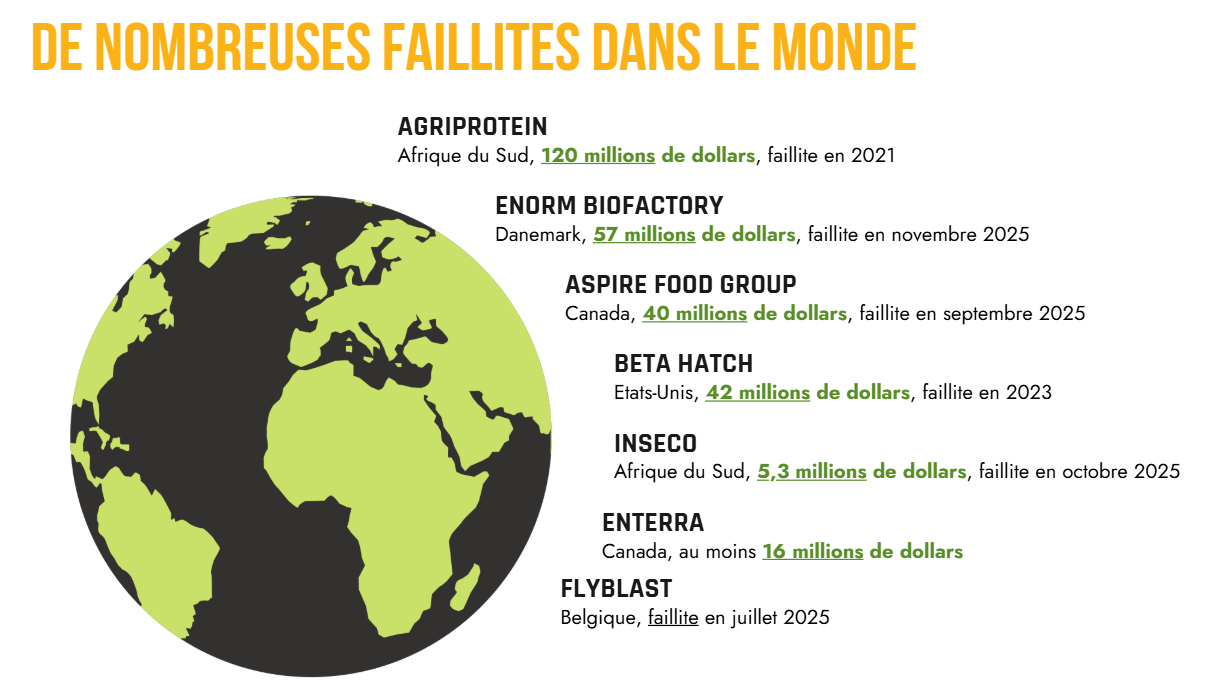
The causes are structural. Insect meal remains two to four times more expensive than fish meal and up to nine times more expensive than soybean meal. The main target market, livestock feed, remains largely out of reach due to price, volume, and standardisation issues. As for human consumption, acceptance is very limited: only 2 out of 10 French people say they are curious to try insect-based products. The shift toward pet food, by definition a niche market, will only be able to accommodate a limited number of players.
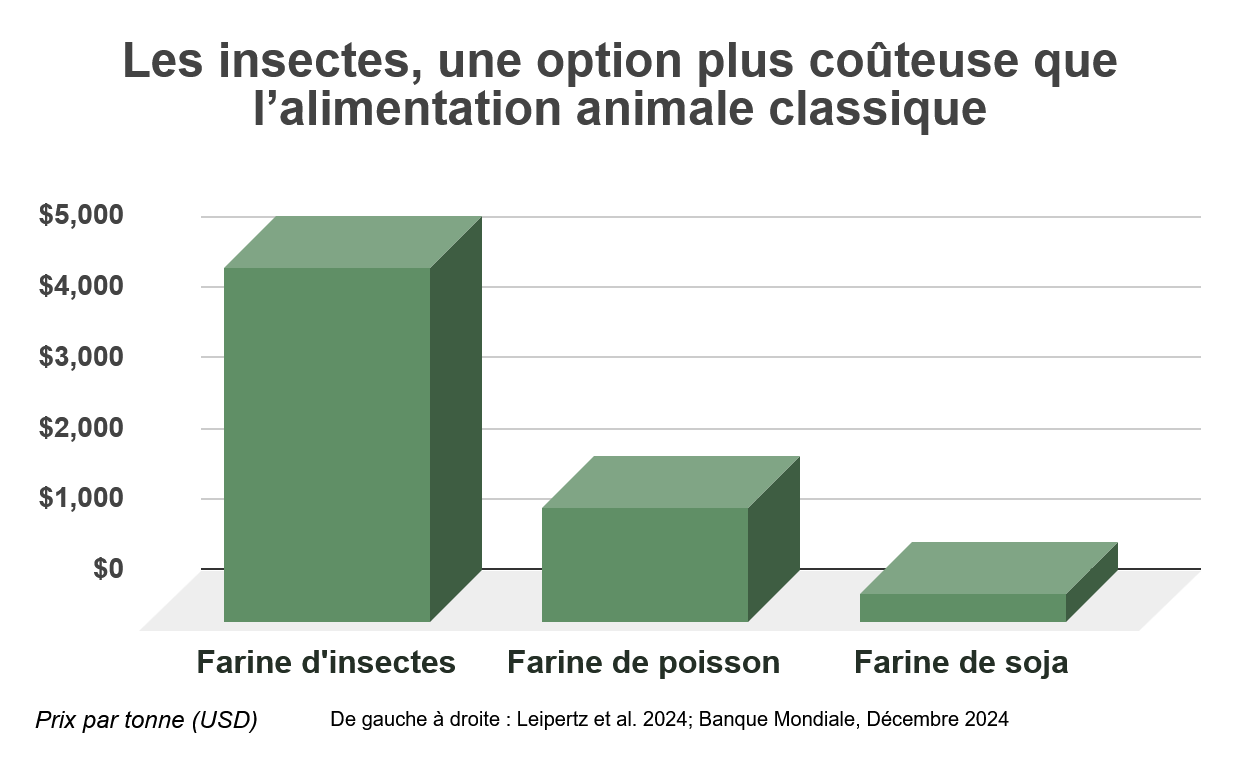
Approximate cost of insect meal (left) compared to fish meal (middle) and soybean meal (right) in 2024
Unproven environmental benefits
The environmental benefits have played a central role in justifying public support. Recent scientific research has cast serious doubt on it.
A life cycle assessment commissioned by the UK Department for Environment, Food and Rural Affairs estimates that insect meal can emit up to 13.5 times more greenhouse gases than soy. In the pet food sector, insect proteins emit 2 to 10 times more greenhouse gases than the conventional products they replace.
When it comes to human consumption, the comparison with beef, which is ubiquitous in the industry’s communications, does not reflect market reality. More than 90% of insect-based products (bars, snacks, pasta) replace plant-based ingredients, whose carbon footprints are lower than those of insects. Incorporating insects into these products therefore increases their environmental impact rather than reducing it.
The rhetoric surrounding the circular economy does not reflect actual industrial practices. The industry uses very little actual food waste, which is prohibited as a substrate under European regulations, and relies on agricultural byproducts already utilised by other sectors.
Our recommendations
ObSAF and ONEI have issued four recommendations for public authorities:
Reevaluate public aid and subsidies
Suspend public support until independent life-cycle assessments, conducted under real-world industrial conditions, have demonstrated a net environmental benefit compared to existing alternatives.
Redirect public aid and subsidies to ensure greater consistency
Redirect public resources allocated to the food transition toward solutions whose environmental effectiveness has been more thoroughly demonstrated by research, such as plant-based proteins.
Improve transparency regarding aid and subsidies provided to the sector
Publish a consolidated report on all aid granted to the sector, including the amounts invested by BpiFrance, a significant portion of which remains unclear.
Examine the decision-making processes that led to this funding
Examine the decision-making processes that led to the investment of hundreds of millions of euros in an industry whose limitations had already been documented in the scientific literature. A transparent review would allow lessons to be learned for other emerging sectors.
Who are we?
ObSAF documents public funding in the agricultural sector in France and the policy choices that shape agricultural supply chains. Its goal is to take a critical look at agricultural subsidies and aid to analyse their effects on food systems and to help guide public policy.
ONEI is the leading independent organisation in France dedicated to providing information on insect farming. We have published several scientific studies in peer-reviewed journals focusing on the environmental and economic challenges facing the sector.
You can contact us via our contact form or by email at: contact@onei-insectes.org